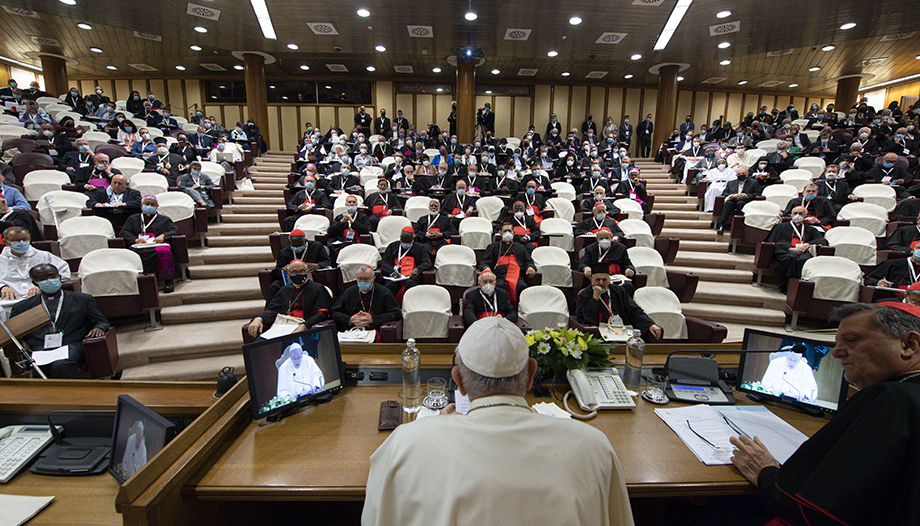
The XVI Ordinary General Assembly of the Synod of Bishops will have, for the first time, non-bishop members with the right to vote. There will be 10 members of religious orders (5 women and 5 men) and 70 non-bishops, including priests, consecrated persons, deacons and lay faithful.
Together with the incorporation of a new figure, the facilitatorsThe main novelty of the next Assembly will be the presence of experienced people whose task will be to facilitate the work at the different moments of the Assembly. Ordinary General Assembly of the Synod of Bishops focused on the theme of synodality.
The note issued by the Holy See points out that "the current regulations continue to refer to the Apostolic Constitution Episcopalis Communio with some modifications and novelties" and refers to Pope Francis' approval of "the extension of participation in the Synodal Assembly to 'non-bishops' (priests, deacons, consecrated men and women, lay men and women). This choice is in continuity with the progressive appropriation of the dimension of the synodal dimension. synodal constitutive of the Church and the consequent understanding of the institutions through which it is exercised".
Ten religious replace the "ten clerics".
The ten religious men and women who will form part of this Assembly replace the "ten clerics belonging to Institutes of Consecrated Life, elected by the respective organizations representing the Superiors General" that were foreseen in previous synods.
The nuns will be chosen by the International Union of Superiors General and the male ones by the Union of Superiors Generalrespectively.
Women and young people, chosen by the Pope
In addition, this Synod will have another 70 new members who will come from the local Churches. Among them are expected to be priests, consecrated persons, deacons and lay faithful.
Although each of the International Meetings of the Episcopal Conferences and the Assembly of Patriarchs of the Eastern Catholic Churches will propose 20 names, the new members will be chosen by the Pope from the resulting list of 140 persons. Among them, it is specified "that 50% of them be women and that the presence of young people is also valued". They will have the right to vote, something they did not have before, and it has been requested that "not only their general culture and prudence, but also their knowledge, both theoretical and practical, as well as their participation in various capacities in the synodal process" be taken into account.
On the other hand, the Holy See indicates, "in addition to the 70 non-bishop members mentioned above, it is worth mentioning that it will also be possible to count non-bishop members among the pontifically appointed members".
The last novelty of this Assembly refers to "the representatives of the Dicasteries" that will participate and that "are those indicated by the Holy Father".
The note issued by the Holy See also recalled that "all elections must be ratified by the Roman Pontiff", that is, the Pope must approve the names proposed, bishops or not, to be members of this Assembly.
Some bishops' conferences, such as the Spanish one, have already announced that they have sent to Rome their proposal of bishops as synod fathers.
The names of those elected will not be released until their election has been confirmed by the Pope.
Non-voting participants
The Holy See recalled that, in the Assembly, "other persons who do not have the title of "President" also participate in the Assembly. member"i.e., "who do not have the right to vote".
These non-voting participants include experts and, for the first time, facilitators, that is, experienced people whose task will be to facilitate the work at the different moments of the Assembly, as well as "fraternal delegates, members of other Churches and Ecclesial Communities", as the Vatican has pointed out.
An impulse to episcopal specificity
According to the Holy See, this broadening of participation in the Assembly "reinforces the solidity of the process as a whole, incorporating in the Assembly the living memory of the preparatory phase, through the presence of some of those who were its protagonists, thus restoring the image of a Church-People of God, founded on the constitutive relationship between common priesthood and ministerial priesthood, and giving visibility to the circular relationship between the prophetic function of the People of God and the discernment function of the Pastors".
The entry of non-bishop members into the Ordinary General Assembly of the Synod of Bishops not only does not dilute but "confirms" the episcopal specificity of the Assembly (bishops continue to represent 75% of the participants) but, at the same time, "does not limit its composition".