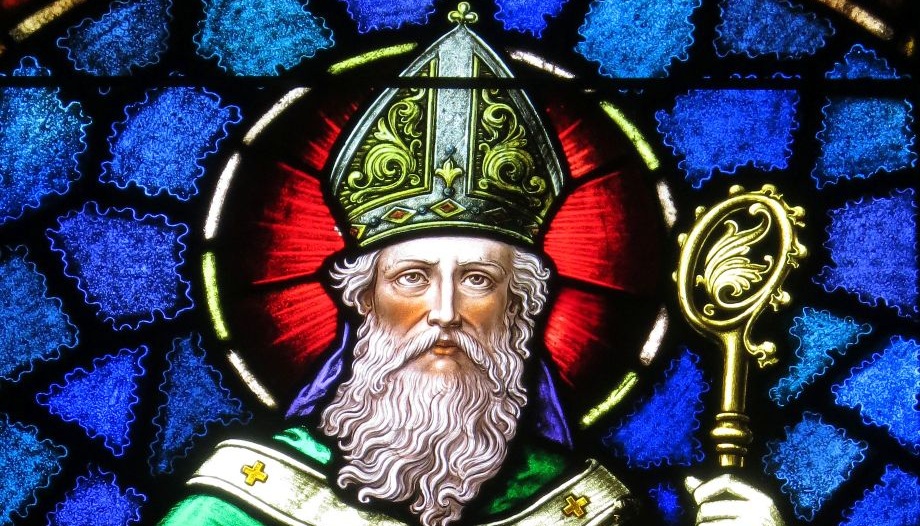
St. Patrick's Day is one of the most celebrated holidays around the world, despite the fact that he is the patron saint of Ireland, a rather small country. However, this paradox makes more sense if you take into account that St. Patrick was not even Irish, so if Ireland celebrates him, the rest of the world has an excuse too.
The patron saint of Ireland was actually born in Scotland, in a small village where he stayed until he was 16 years old. At that time, a group of Irish pirates kidnapped the young man to sell him into slavery. For this reason, during the following years of his life Patrick tended his owner's sheep in the north of Ireland, where he learned the native language and became familiar with the customs.
Long working days allowed St. Patrick to spend many hours in dialogue with God. It was at this time that he learned the value of prayer and took the opportunity to ask Christ to help him discern his will.
France and the call of God
One night, God inspired him to flee to the coast. Arriving at a port, after walking for miles without really knowing what was going to happen, St. Patrick found a ship bound for France. He immediately knew that this was where he had to go, but the captain of the ship refused to let him on board, probably because he realized that the young man was in fact an escaped slave.
After praying insistently, Patrick managed to convince the captain and traveled to France, where he met St. Germain. Again, there God enlightened him and asked him to become a monk. Under the tutelage of his master, Bishop of Auxerre, St. Patrick studied Sacred Scripture in depth and, after several years, set out for Rome to complete his education.
Once in the Eternal City, the monk received priestly ordination and Pope Celestine approached him with a proposal: to consecrate himself as a bishop and return to Ireland to evangelize the pagan tribes of the country.
St. Patrick returns to Ireland
Forgetting the bad time he had had in Ireland, St. Patrick accepted the Pontiff's commission and set sail for the island, where again they did not want to receive him. The tribesmen took Patrick prisoner, tortured him and tried to kill him, but the bishop gradually won the confidence of the chiefs. Through very simple preaching, he succeeded in getting them to accept the Gospel message.
After converting the authorities of the communities, they released St. Patrick, who began to travel throughout the island of Ireland following the same strategy: first approaching the chiefs and their families, so that the other members of the tribes would lose their fear and also sit down to listen to him.
As the priest knew well the customs of the Irish, he was able to adapt to them and, thanks to his work, many inhabitants received the Catholic faith. St. Patrick recorded his preaching in his Confessions, where he also narrated his life before his death on March 17, 461.
Between legend and history
Despite these writings, many elements of St. Patrick's life are part of the legend. The best known of these is his feat of ridding Ireland of snakes: an animal that never actually inhabited the island. Other details are more plausible, such as his famous use of the three-leaf clover as an image to explain the Holy Trinity. From here comes the famous identification of Ireland with this plant.
Despite the fact that St. Patrick never left Europe and spent a long time as a prisoner, his feast day is the most celebrated national event in the world. The fact that millions of Irish people have left the island throughout history to emigrate to other countries means that they have transferred their customs to new places where St. Patrick is still remembered with affection (and one too many beers).
For years, the Catholic Church in Ireland tries to give back to the celebration of March 17 its religious meaning. For the faithful of the country it is a day of obligation on which they go to Mass to give thanks for the courageous witness of that pastor who was not afraid to return to the island to bring the Gospel to a country that even today is known worldwide for its faith, despite the difficulties Catholics in recent years.