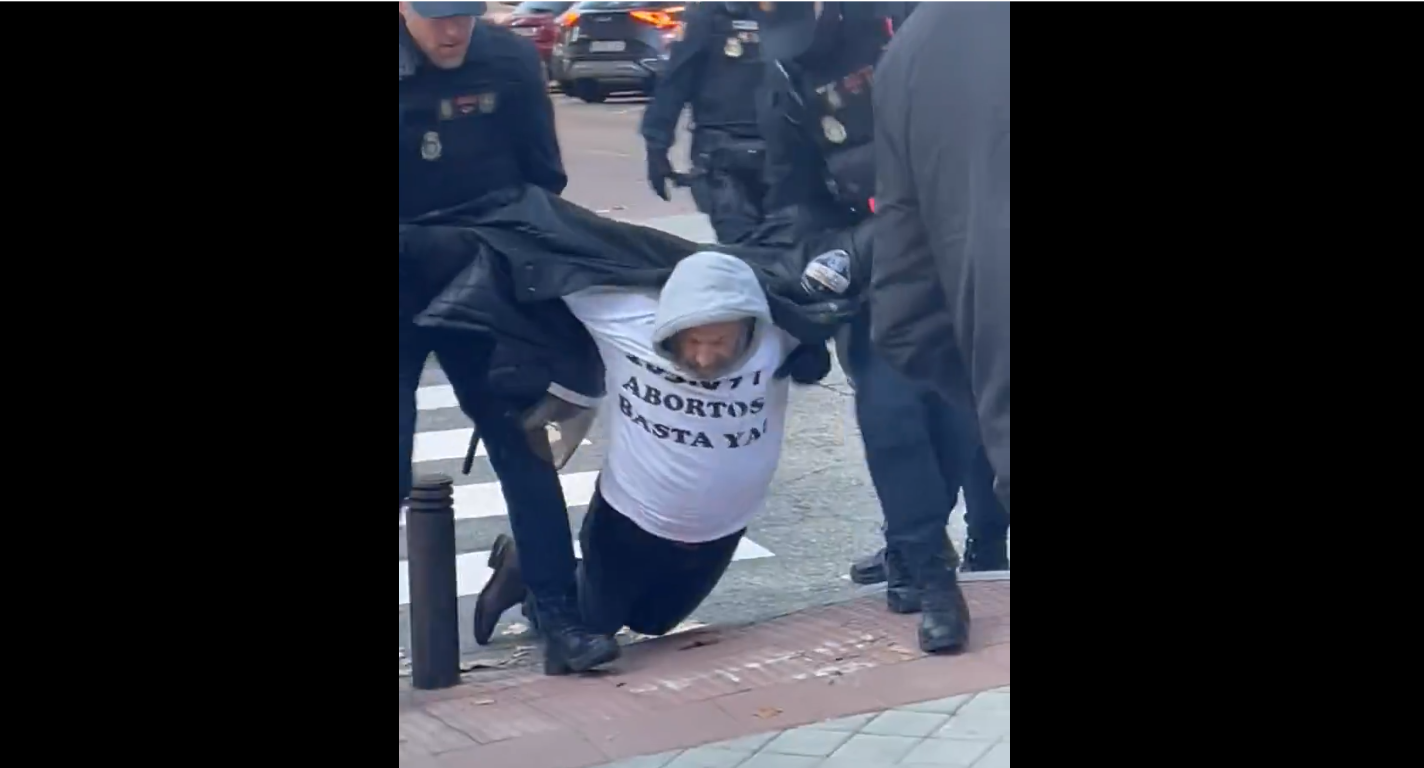
Once again this year, Dr. Jesús Poveda has gone to his appointment in front of the Dator clinic in Madrid. It is a ritual that this Spanish pro-life leader attends every December 28, the day of the martyrdom of the Holy Innocents. Poveda shows up at the door of the clinic, the police ask him to leave, he sits on the ground and the agents take him away for contempt of authority. As Poveda often repeats, "we do assistance 364 days a year and one day only one day we do passive resistance".
The scene is no more controversial, but it is very timely to reflect on the ethical, legal and social limits of the defense of life, a debate that remains one of the most polarizing of our time. Beyond the controversies and headlines, what is really surprising is the intensity of the moment: a peaceful protest and an arrest that seeks to silence something deeper than mere ideological dissent.
Sandel's criticism of pro-lifers
Philosopher Michael Sandel, 2018 Princess of Asturias Laureate and one of Harvard's most acclaimed professors, posits in. "Against Perfection." an argument that deserves our attention. As a member of the U.S. President's bioethics advisory committee, for years he listened to the opinions of renowned physicians for and against abortion. What struck him, however, is that most pro-life gynecologists are on friendly terms with colleagues with whom they disagree on this issue. According to Sandel, this is a huge inconsistency, because if he believed that abortion involves the death of millions of innocent human beings, his reaction and activism would be much more vehement.
In his opinion, the lukewarmness with which many pro-lifers express their rejection of abortion is evidence that, deep down, they do not fully believe in what they are defending. As proof, he points out that very few devote 50 euros a year to the cause and their activism is usually limited to participating in one or two demonstrations. On closer inspection, it is difficult not to concede that he is partly right.
Inconsistency in the pro-abortion discourse
Paradoxically, Sandel's criticism of the "incoherence" of pro-life actions can also be applied to the pro-abortion discourse. Many countries, including Spain, have moved toward extreme restrictions that seek to prohibit even praying in front of abortion clinics. This not only limits the right to freedom of speech and conscience, but also reveals a contradiction in the pro-abortion narrative. If abortion is a legitimate medical intervention devoid of serious ethical implications, why so vehemently repress any form of peaceful opposition? Are we not in a pluralistic and free society?
The ban on praying in the vicinity of abortion clinics is a clear example of how the debate is not just about defending individual rights, but about silencing uncomfortable speech. Is this not a tacit admission that the issue is morally thorny? Instead of confronting the debate, it seems to seek to avoid any reminder that what goes on inside clinics is not an ethically neutral act.
Where are the limits?
The dilemma posed by Sandel and the actions of activists like Jesús Poveda confront us with essential questions about the limits of the defense of life. What are we willing to sacrifice for what we consider just? What kind of protest is valid and proportional when it comes to issues as fundamental as human life?
For those who believe that life begins at conception, the defense of life cannot be limited to words. Nor can one resort to violence or coercive imposition, as this would compromise its moral legitimacy. However, between these two extremes, is there not room for gestures and actions that seek to raise public awareness of this problem? Is it not valid to offer an ultrasound scan to those who are considering abortion? Is it not legitimate to offer aid, both public and private, to women who face the drama and difficulty of continuing their pregnancy?
One cannot demand coherence from those who defend life while they are prohibited from freely expressing their convictions. The arrest of Dr. Poveda during a peaceful protest highlights this contradiction: on the one hand, pro-lifers are accused of not being coherent with their convictions and, on the other hand, legal restrictions are imposed on them that limit even symbolic acts such as praying in front of an abortion clinic. This approach hinders an honest debate on the value of life and abortion, silencing one side. We must guarantee the right of all to express their positions; only in this way is an authentic and fair dialogue possible.