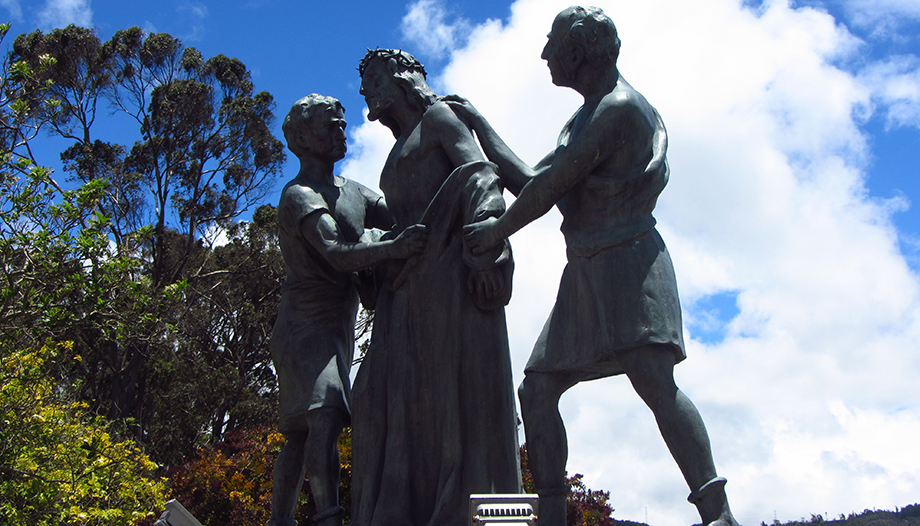
"The brotherhood has to be a family!", this is a statement that any brotherhood assumes without reservation and one of the priority objectives of all the older brothers; to achieve it, it is necessary to identify the main differentiating notes of the family and try to replicate them in the brotherhood:
Vocation: For a Christian, the family is not simply a social institution; it is an authentic human and supernatural vocation, based on the love of the spouses.
Mutual support and acceptance: In the family, love must manifest itself in the simplest and most everyday gestures. It knows joy and hope, but also fatigue and pain, and overcomes them thanks to love, which springs from a willingness to be together, to help each other, which is confirmed daily in an unconditional acceptance of the other.
Personal development in freedomThe family is not only a place of coexistence, but the place where the personality is formed, taught and learned to love and serve. This love is part of the ontological structure of each person, and must be developed in the family from personal freedom.
Having defined these principles, to proclaim that "the brotherhood must be a family" is to recognize that God has from eternity disposed our vocation as a brotherhood as a means of sanctification and for this reason the brotherhood must reflect those characteristics of the family.
Not everything is always so ideal. In any human group, even in families and sisterhoods, difficulties and divisions arise, as the Pope acknowledges: "Living in a family is not always easy, it is often painful and tiring, but I believe that one can apply to the family [and to sisterhoods] what I have said more than once about the Church: I prefer a wounded family [a sisterhood], which tries every day to combine love, to a family [sisterhood] and society sickened by selfishness and the comfort of fear of loving". (16.02.16)
However, there are situations in which difficulties become entrenched and lead to unedifying situations, how do you get there?
In our society, and brotherhoods are part of society, there is a tendency to undervalue the creative force of critical thinking, confusing discrepancy with disloyalty, opposition with tension, autonomy with self-determination. Unwavering adherence is no longer demanded, but uncritical adherence. What is different is frightening and we try to suppress it, in order to reaffirm the goodness of our approaches, even with small gestures, such as refusing to greet or treat others cordially.
This attitude, maintained over time, generates a tendency to distinguish between "us" and "them". The next step is to strip "them", those who think differently, of their individual traits: they do not exist as individuals, they are an abstraction, a collective that, as such, is not subject to rights. From this point on, our morality and principles only apply to us, to those in our group.
This approach may seem exaggerated, but when someone settles into this attitude, he ends up not finding any connection between his world, the only one he considers real, and that of others, whom he sees as an undifferentiated collective that he reifies, consequently the moral rules are only applicable to his own, not to others. Thus, unedifying behavior towards them is legitimized, denying greetings, criticizing them, isolating them, suspending personal responsibility.
Normally those who act in this way are good people, who would not kill a fly, but who have assumed the banality of evil in such behavior, as Hannah Arendt explained in her chronicles of the "Eichman in Jerusalem" trial.
What is the role of "the others", those whom the corporation of the biempensantes have placed on the other side? not, of course, to establish a dialectical struggle to impose their approaches, but to promote them with freedom, aware that this has its costs, and fortitude, a patient fortitude, without resignation or renunciation, firm without provocation, prudent, to actively promote desirable progress and without renouncing their convictions, aware that when one gives in or renounces them or conceals them, out of weakness, for not going against the current, for not being criticized or for maintaining a status, one debases oneself and leads one's surroundings to weariness, sadness and mediocrity (Cfr. St. John Paul II: 1.01.1979).