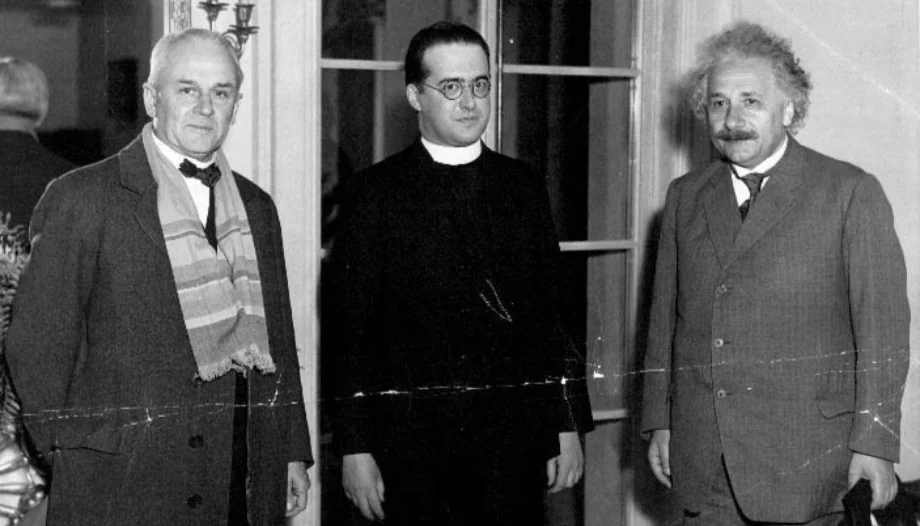
Can a priest also be a great scientist? The story of Georges Lemaître proves that he can. This Belgian physicist, who was also a Catholic priest, not only naturally combined science and faith, but revolutionized our understanding of the universe. In fact, he was the first to propose what we know today as the Big Bang theory.
A priest with a scientific vocation
From a young age, Lemaître dreamed of two things: being a scientist and being a priest. He studied engineering, philosophy, physics and mathematics, and served as a volunteer in the First World War. He then entered the seminary and was ordained a priest. But his passion for knowledge did not stop there.
He discovered Einstein's theory of general relativity through the texts of astronomer Arthur Eddington, with whom he would later study at Cambridge. Fascinated by the new ideas about space and time, Lemaître began to explore how they could be applied to the entire universe.
An expanding universe
Until then, most scientists believed in a static universe. Lemaître thought otherwise: if the universe was full of galaxies moving away from each other - as some observations indicated - then it must be expanding.
With that idea in mind, in 1927 he proposed a mathematical model in which the universe expanded over time. This expansion explained a phenomenon known as "redshift": more distant galaxies move away faster. Years later, Edwin Hubble observed exactly that, giving strong empirical support to Lemaître's hypothesis.
The origin: the "primitive atom".
But Lemaître went further. In 1931 he presented an even bolder idea: the universe had started from an extremely dense and hot point that he called the "primitive atom". That was the first scientific formulation of the origin of the universe, known today as the Big Bang theory.
Instead of imagining an eternal universe, he proposed one with a beginning, where space and time emerged from an initial cosmic explosion. Although at first the scientific community received this idea with skepticism - and some even thought that Lemaître was seeking to introduce biblical creation into science - he was always clear: his model was a scientific, not a religious, proposal.
Faith and science: two paths to truth
Far from using science to "prove" the existence of God, Lemaître insisted on maintaining a healthy separation between faith and science. For him, both sought truth, but from different planes: science explains the "how" of the universe; faith, the ultimate "why" of existence.
Lemaître believed that God does not replace natural laws, but is the foundation of all that exists. In his own words, "God must not be reduced to a scientific hypothesis." He asserted that Revelation was not intended to teach science, and that a believing scientist could investigate as freely as anyone else.
The legacy of the "father of the Big Bang
Throughout his life, Lemaître was recognized for both his scientific brilliance and his profound humility. His ideas were the foundation of modern cosmology. Shortly before his death, he learned of the discovery of the cosmic background radiation, an "echo" of the Big Bang that confirmed his theory. It was a symbolic moment: science had finally confirmed what he had glimpsed decades earlier.
Today, his figure inspires many as an example that science and faith need not be at odds. Georges Lemaître lived convinced that the universe is rational, beautiful and accessible to human intelligence, precisely because it is the work of a Creator.
And perhaps for that reason, he was able to see farther than many: to the very origin of the cosmos.