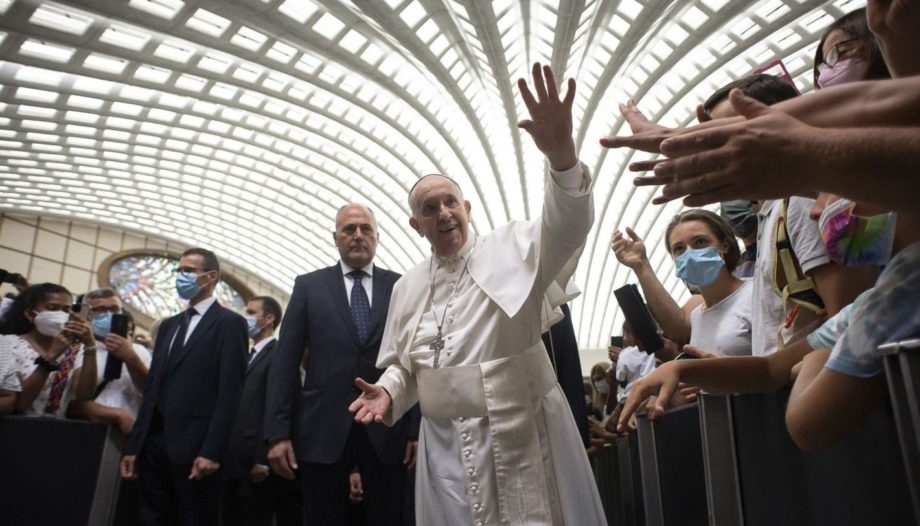
Pope Francis held the general audience in which he asked about the role of the "Law" commenting on the Letter of St. Paul to the Galatians: "St. Paul has taught us that the "children of the Promise" (Gal 4:28), through faith in Jesus Christ, are not under the bond of the Law, but called to the arduous way of life in the freedom of the Gospel. But the Law exists. Therefore, in today's catechesis we ask ourselves: what is the role of the Law according to the Letter to the Galatians? In the passage we have just heard, Paul maintains that the Law has been like a pedagogue. This is a beautiful image that deserves to be understood in its true meaning.
"The apostle," says the Pope, "seems to suggest to Christians to divide the history of salvation, and also their personal history, into two moments: before they became believers and after they received the faith. At the center is the event of the death and resurrection of Jesus, which Paul preached to arouse faith in the Son of God, the source of salvation. Therefore, starting from faith in Christ, there is a "before" and an "after" with respect to the Law itself. The preceding history is determined by being "under the Law"; the successive history is lived following the Holy Spirit (cfr. Gal 5,25). This is the first time Paul uses this expression: to be "under the Law". The underlying meaning carries the idea of a negative subjection, typical of slaves. The Apostle makes it explicit by saying that when one is "under the Law" one is as it were "guarded" or "closed", a kind of preventive custody. This time, says St. Paul, has lasted a long time, and is perpetuated until one lives in sin".


"The relationship between the Law and sin will be exposed in a more systematic way by the apostle in his Letter to the Romans, written a few years after the Letter to the Galatians. In synthesis, the Law leads to define transgression and to make people aware of their own sin. Moreover, as common experience teaches, the precept ends up stimulating transgression. Thus he writes in his letter to the Romans: "For when we were in the flesh, the sinful passions, aroused by the Law, were at work in our members, so that we bore fruit unto death. But now we have been freed from the law" (7:5-6). In a lapidary way, Paul fixes his vision of the Law: "The sting of death is sin, and the power of sin is the Law" (7:5-6).1 Cor 15,56)".
"In this context", Francisco continues, "the reference to the pedagogical role developed by the Law acquires its full meaning. In the school system of antiquity, the pedagogue did not have the function that we attribute to him today, that is, to support the education of a boy or a girl. At that time he was a slave who had the task of accompanying the master's son when he went to the teacher and then accompanying him back home. He had to protect him from dangers and watch over him so that he would not behave inappropriately. His function was more of a disciplinary one. When the youngster became an adult, the pedagogue ceased his functions".
"Referring to the Law in these terms allows St. Paul to clarify the role it played in the history of Israel. The Torah had been an act of magnanimity on the part of God with his people. Certainly he had had restrictive functions, but at the same time he had protected his people, educated, disciplined and sustained them in their weakness. This is why the apostle pauses successively in describing the phase of minority: "While the heir is a minor, he differs in nothing from a slave, being master of all, but is under tutors and stewards until the time appointed by the father. In the same way, we too, when we were minors, lived as slaves under the elements of the world" (Gal 4,1-3). In summary, the apostle's conviction is that the Law certainly has its own positive function, but it is limited in time. Its duration cannot be extended beyond all measure, because it is linked to the maturation of persons and their choice of freedom. Once faith is attained, the Law exhausts its propaedeutic value and must give way to another authority".
In conclusion, Pope Francis stressed that "this teaching on the value of the law is very important and deserves to be carefully considered so as not to fall into misunderstandings and make false steps. It will do us good to ask ourselves whether we still live in the age in which we need the Law, or whether we are instead aware of having received the grace of having become children of God in order to live in love."