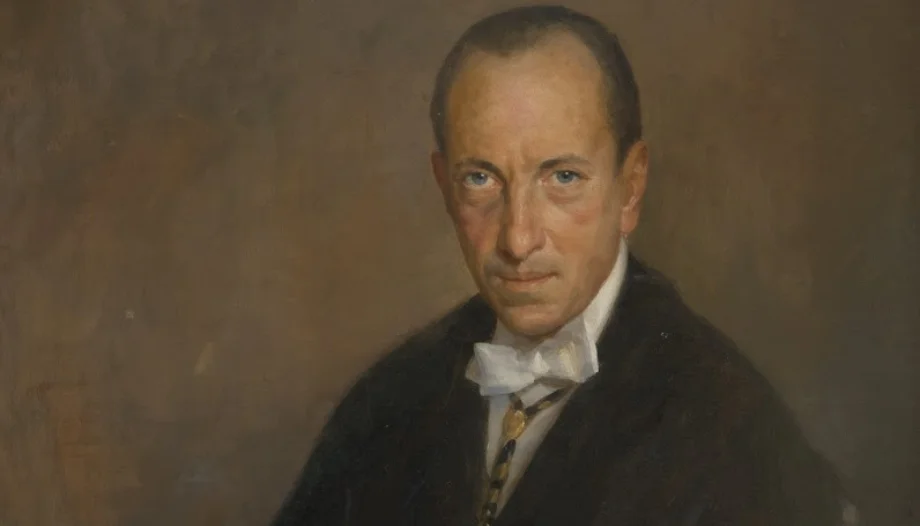
Enrique Gutiérrez Ríos (December 12, 1915 – August 8, 1990) was a chemist born in Madrid who, in 1940, began his doctoral dissertation at the Institute of Soil Science under the supervision of Father José María Albareda, who greatly influenced his scientific and administrative training. He later held the chair of Inorganic Chemistry at the University of Granada and the Complutense University of Madrid. At the latter, he served as rector (1964–1967).
His scientific career was also closely linked to the CSIC, where he held various positions: director of the Zaidín Experimental Station in Granada (1954–1957) and of the «Elhuyar» Institute of Organic Chemistry (1983–1984), as well as vice president (1967–1971) and president (1973–1974).

He also held important positions at various institutions: he served as president of the Royal Spanish Society of Physics and Chemistry (1966–1970) and of the National Council of Education (1968). He also earned his doctorate honoris causa from the University of Granada in 1972 and received the Individual Research Award from the Juan de la Cierva Foundation (1948), the Francisco Franco Prize for Science (1966) and the José María Albareda Prize (1969), as well as the Grand Cross of the Civil Order of Alfonso X the Wise. Furthermore, he was a member of the Royal Academies of Pharmacy and of Exact, Physical, and Natural Sciences, and held prominent positions in government and scientific circles: he served as president of the Advisory Commission on Scientific and Technical Research of the Office of the Prime Minister, as a Councilor of the Realm representing Spanish universities, and as director of the CSIC’s «Elhuyar» Institute of Inorganic Chemistry.
As a researcher, he focused on structural inorganic chemistry, with a special emphasis on clays, bentonites, and montmorillonites, introducing innovative techniques such as X-ray crystallography for the thermal and structural characterization of silicates. He published more than 150 papers in national and international journals, obtained patents on minerals and interlaminar compounds, and wrote seminal books such as Inorganic Chemistry, who influenced several generations of chemists. He also took an interest in science outreach and culture, publishing various works and biographies of Spanish scientists.
As for his faith, he joined Opus Dei in 1954 and remained a member until his death, which occurred in Madrid. He was married and had six children.