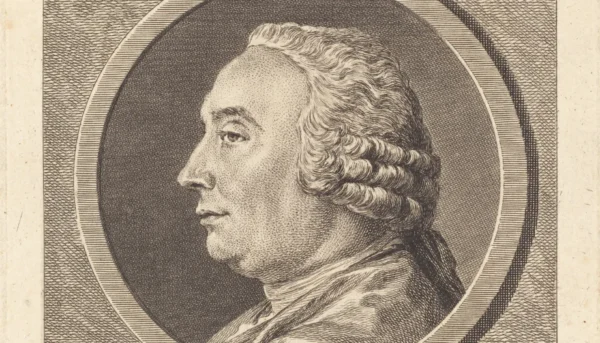


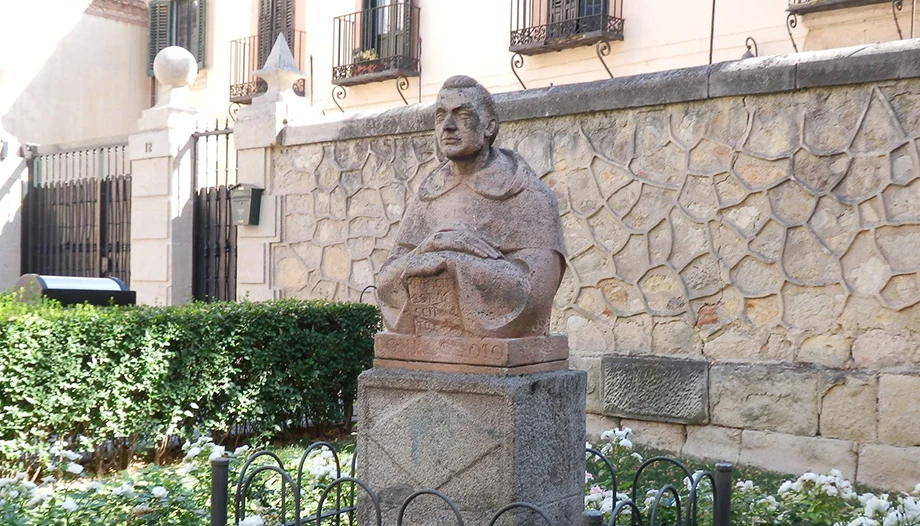
The Dominican Domingo de Soto (Segovia 1494 - Salamanca 1560), was one of the leading scholars of the Spanish Golden Age. After his training at the University of Paris, he was first a professor at the University of Alcalá and then at the University of Salamanca (in between he joined the Dominican order). His intellectual legacy spans several disciplines. In particular, he is a key figure in the transition from the medieval prehistory of physics to the emergence of modern physics. Proof of the breadth of his erudition is that university students of the time used to say: "Whoever knows Soto, knows everything".
In the theological field, Soto distinguished himself for his acute exploration of the problem of grace and nature, contributing significantly to the theology of his time. In fact, he participated in the Council of Trent.
His insight extended to philosophy, economics and law, where he left his mark with the first treatise on the rights of the poor and the formation of the Ius Gentium in defense of the indigenous people, the basis of today's international law.
As far as science is concerned, Domingo de Soto was a pioneer in the description of motion, anticipating by a century the ideas that Galileo would later establish experimentally. His conception of free fall motion as uniformly accelerated in time was of vital importance for the birth, a century and a half later, of Newtonian mechanics, since it postulates a uniformly accelerated motion in every body subjected to a constant force.
In addition, Soto introduced the notion of inert mass or internal resistance to motion, a fundamental concept in Newtonian mechanics. This contribution, often attributed to Galileo, reveals the depth of Soto's scientific thought, whose ideas were essential to the birth of physics.
The diffusion of Soto's teachings spread from the University of Alcalá to the Roman College, thus influencing the formation of Galileo. It had to be the French thermodynamicist Pierre Duhem who, in his research on the prehistory of physics, discovered the crucial contribution of this illustrious compatriot of ours, who personifies the synergy between faith and reason in the search for knowledge.