
The history of the Catholic Church has had examples of what we would know today as job placement initiatives for centuries, many of them linked to the training and preparation of men and women for various tasks.
However, it will be after the publication of the encyclical Rerum Novarum The encyclical of Leo XIII when the Church's commitment to the working world took shape and numerous committed faithful, especially lay people, started up brotherhoods, associations and projects that, in addition to being a channel for evangelization in the working world, pursued the dignification and improvement of workers' conditions and access to decent employment. An encyclical that would update, almost a century later the Laborem exercens of St. John Paul II and whose central theme: work, would be a key part of the Fratelli Tutti of Pope Francis.
In Spain, the response to this encyclical would come from the hand of Guillermo Rovirosa with the foundation of the Hermandad Obrera de Acción Católica, which celebrates its 75th anniversary in 2021. As members of HOAC recalled in an interview granted to Omnes and collected in the January 2021 issue, "The evangelizing commitment of the working class world has been advancing at the pace of the same evolution of society". At present, the labor crisis resulting from the effects of Covid 19 has accentuated the gap that had been dragging on, especially since the 80s, between the different employment sectors, exacerbating the problems of those who already started from a precarious position, as HOAC points out.
The situation of millions of people affected by redundancies, layoffs and salary reductions is a sign of the "throwaway society" as Pope Francis has expressed it: "this discarding is expressed in many ways, such as in the obsession to reduce labor costs, which does not take into account the serious consequences that this causes, because the unemployment that is produced has the direct effect of expanding the frontiers of poverty" (FT, 20). (FT, 20)
In view of this situation, the initiatives that the Church, through different organizations, carries out in favor of employability and the dignity of people through employment, stand out.
Caritas
The Caritas 2020 report includes the task of social and labor insertion itineraries, where people are accompanied in the development of actions necessary to improve their level of employability, together with the promotion of insertion companies, special employment centers and other social enterprises, with which protected employment is created for people who do not find an opportunity in the labor market.
Last year Caritas allocated 17% of its resources, some 57,574,350 €, to Employment, Fair Trade and Social Economy, being the second area of investment after shelter and assistance.
Some examples of these projects developed by Cáritas in different Spanish dioceses are the "Sementeira formación laboral" project in Ourense, aimed at the training and employability of people in situations of social exclusion, the Work Center for people with disabilities in Urgell or the Tabgha Restaurant School in Cordoba, which trains and qualifies people at risk of social exclusion in the hotel and catering sector through a social economy.
Church for decent work
This initiative is promoted by Christian-inspired entities and organizations: Spanish Conference of Religious (CONFER), Hermandad Obrera de Acción Católica (HOAC), Justice and Peace, Young Catholic Students (YCS), Young Christian Workers (YCW) and Caritas, was born in 2015 with the aim of promoting dynamics of awareness, visibility and denunciation on a central issue for society and essential for the lives of millions of people: human labor and to publicize the concept of decent work.

ITD aims to be a loudspeaker for local initiatives in favor of employment and social awareness. It prepares and disseminates materials for prayer, reflection and work that are made known through the various entities and their circles of work and pastoral action.
This year, following the worsening of working conditions as a result of Covid, Church for Decent Work is engaged in the campaign "Now more than ever, decent work", through which they want to raise awareness in society that the time has come to adopt policies and commitments in favor of decent, sustainable and inclusive jobs.
Diocesan initiatives and conferences
There are many Spanish dioceses in which, in recent years, joint projects have been articulated to address the issue of employment as part of the work of the Church.
In Seville we find Joint Action against unemployment. An initiative of the delegations of Social Pastoral - Justice and Peace, Migrations, Diocesan Caritas, Worker Pastoral, Prison Pastoral, Cardinal Marcelo Espínola Foundation, Worker Brotherhood of Action (HOAC), Worker Brotherhoods (HHTT), Christian Cultural Movement (MCC), Focolare Movement and the representation in Seville of the Spanish Conference of Religious (CONFER). Acción conjunta contra el parojo develops a work of analysis, reflection and joint construction of alternatives in parishes, movements and other ecclesiastical instances that promote a new organization of work from the Social Doctrine of the Church (DSI), acting on the injustices that cause job losses, promoting the creation of concrete jobs and taking care of the close relationship with the unemployed. Its actions include training and reflection courses on work and its evangelical and social dimension in different parishes, traveling exhibitions on decent work, meetings with entrepreneurs in search of employability alternatives and the preparation of awareness-raising materials.
Madrid and Bilbao are other dioceses that, during these days, will celebrate days to raise awareness of the need for decent employment.
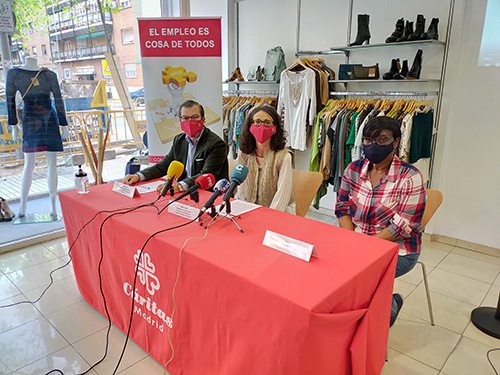
In the case of MadridIn 2020, the diocesan Caritas reported that 60% of the people assisted by Caritas were unemployed and, in the first months of 2021, the number of economic aids processed was more than double that of the same period of the previous year. A situation that has led the Employment Service of Caritas Madrid to launch a series of projects that offer an accompaniment and response to these difficult situations and encourage reflection and help insofar as possible. As Cardinal Osoro pointed out in the pastoral letter on the occasion of this day: "The news of rampant unemployment, shameful employment, business closures, the ruin of small businesses and economic uncertainty lead us to think about the need for a reorganization and a review of our structures".
Bilbao has also joined in this reflection and action for work with the celebration of the First Diocesan Day for Decent Work on April 18. Manuel Moreno, Delegate for Charity and Justice, points out that this day should be an "opportunity to place our gaze as believers on the humanizing meaning of work. Work makes us people, it enables us to share gifts, establish relationships, care and grow as a human family" and he encouraged the parishes of Biscay to pray, work and spread this reality.