Ifema and the Pablo Vi Foundation are hosting, on Saturday, February 24, the congress "The Church in Education: presence and commitment.". The congress is "the point of arrival and departure" of the work that began last October driven from the Episcopal Commission for Education and Culture of the Spanish Episcopal Conference.
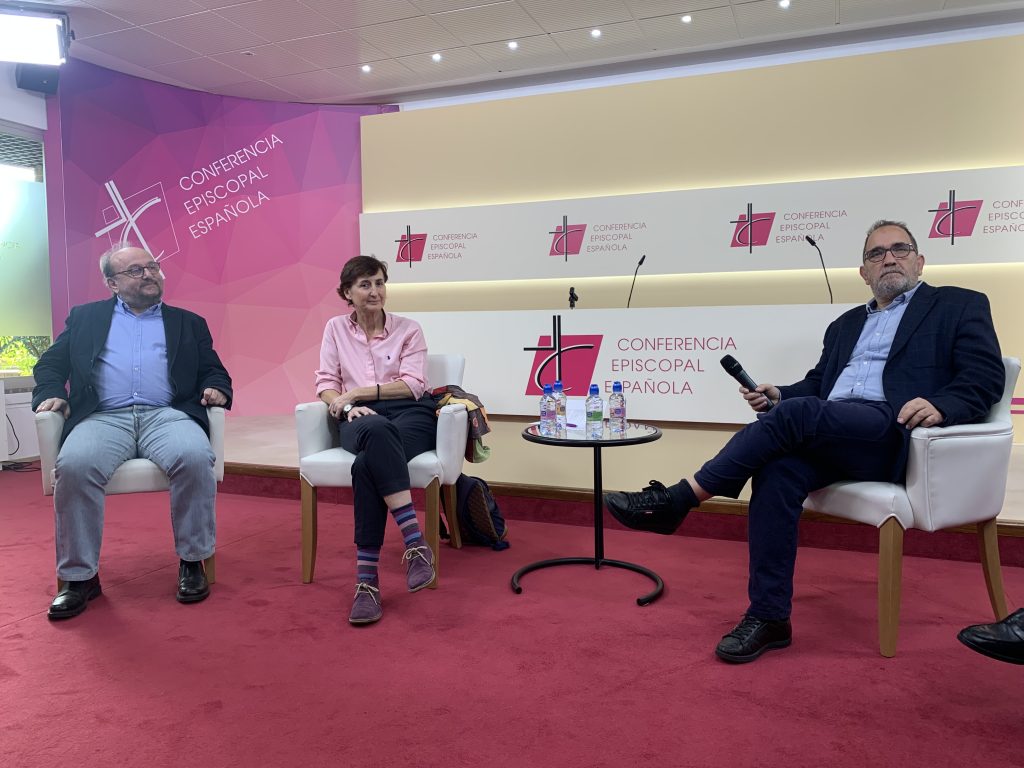
The headquarters of the Spanish Episcopal Conference hosted a briefing for the presentation of this meeting with the participation of the director of the secretariat of the Episcopal Commission for Education and Culture, Raquel Pérez Sanjuánand two members of the "Motor Teams," Antonio Roura Javier and Carlos Esteban Garcés.
Education, "nuclear" in the life of the Church
Raquel Pérez Sanjuan, pointed out that education is "a central theme in the life of the Church, not only because of the broad presence of ecclesial institutions in the world of education, but also because of the commitment to form a way of being a person in the world, in the image of Christ, which is conveyed in education.
Pérez Sanjuan also stressed that the aim of this meeting "is not to draw up guidelines or regulations, but to open up spaces for dialogue in order to respond to new challenges". These challenges will be defined by the participants of the meeting through the dynamics of the development of the day.
Development of the Congress
During the morning, the participants will be grouped according to each of the nine thematic areas in which the Church is present and which have been worked on for months. The areas are: Christian schools; Religion teachers; special education centers; non-formal education; vocational training centers; universities; Christian teachers; colleges and university residences; and good practices of coordination between parish-family-school.
For each of them, there will be a brief presentation by various international speakers, followed by a dialogue and community session to define proposals and challenges on the part of the participants themselves.
In the afternoon, all the congress participants will gather in the IFEMA Auditorium where they will follow the presentations of Cardinal José Tolentino de Mendonça, Fernando Reimers and Consuelo Flecha García and will culminate with a prayer.
The organizers have stressed that, although the reception has been good, it could always be better. Not in vain, around 1,400 people are expected. Among those registered, the majority belong to Catholic schools and religious teachers. To a lesser extent, although with a notable representation, university professors, Christian teachers from other educational realities, members of vocational training centers, as well as teachers from special education centers and directors of senior high schools are also expected.
Carlos Esteban pointed out three objectives of this meeting: to bring together all those who are protagonists of educational projects born in the Church; to exchange experiences and to renew the Church's commitment to education in all its spheres.
In fact, the promoters wanted to point out this "starting point" because the work of the congress "comes after February 24 with its work and development at local or regional level".
More than one million students in Catholic schools
The presence of the Church in Spanish education is more than notable. According to data from the Church's Activities Report for 2022, more than one and a half million students receive education in the 2536 Catholic schools in Spain. As for the teaching staff, there are more than 108,000 teachers in these centers.
These figures highlight the strength and appreciation of Catholic education in Spain, but they do not seem to translate into an increase or strengthening of the faith in most of society. Faced with this reality, Carlos Esteban said at the press conference that "often what is not emphasized is the "generosity with which the Church provides its educational service. It does not do so in exchange for a sacramental response" and wanted to emphasize that there are "other positive impacts of Catholic education in solidarity, appreciation of others...".
Some somewhat diffuse impacts that the promoters of this meeting themselves hope will be the beginning of a change and that they hope that the "fruits in another key, such as religious practice, will also come".