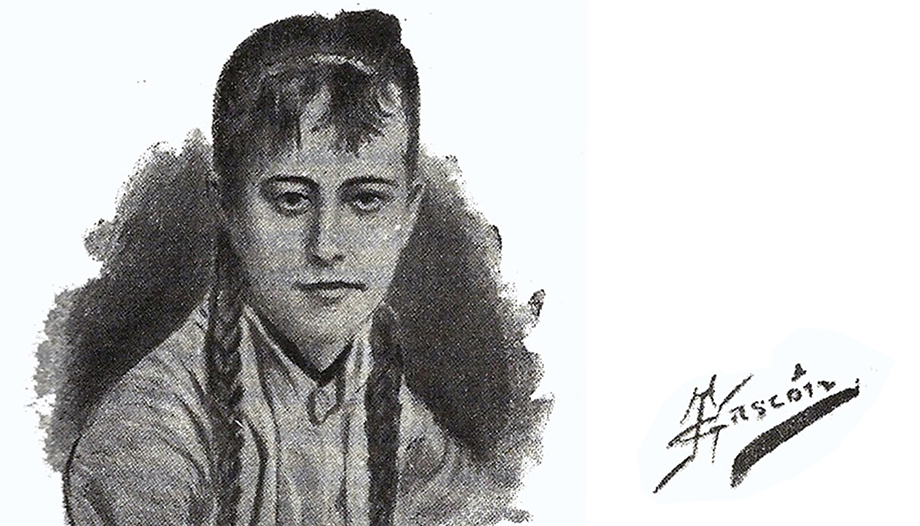
She was born in Calatayud in 1860 and her mother, who had been educated in Switzerland, awakened in Blanca and her sister Clotilde a deep interest in nature. They spent long periods of time at the family's residence in the Albarracín mountains, La Campana. In this place there was a chapel and a library. While Clotilde was more interested in the world of insects, Blanca would draw and describe in detail the plant species she found in that special place.
Blanca counted on the help of the canon of Albarracín, the naturalist Bernardo Zapater, to help her. This religious man, with an excellent background in mathematics, physics and humanities, had frequented the Madrid circles of naturalists and scientists. It was he who put her in contact with the German botanist Moritz Willkommwho was then preparing his great work on the Flora Hispanica. When Willkomm received Blanca's notes, he wanted to inscribe her name next to the main plant collectors in his work on Spanish flora.
Its catalog includes 83 species of plants, one of them a previously unknown species: the white saxifrage, a name that describes how this flower is born breaking the hard rock of the Sierra.
Two herbariums of Blanca Catalán are still preserved: one with the rare plants of Valdecabriel, in Albarracín, which is a unique place for the variety of flowers it has, and another with those of the Vallée d'Ossau, next to the Formigal resort.
In addition, Canon Zapater put Blanca in contact with the Aragonese botanist Francisco Loscos Bernal, who included her in his Tratado de plantas de Aragón and for which Blanca is the first woman to appear in the universal scientific nomenclature.
When she married, she moved to Vitoria, where she died of a lung disease at the age of 40, on March 17, 1904. Her grandchildren have preserved Blanca's legacy, which faithfully reflects her cultural, scientific and religious concerns. A sample are the poems she wrote about nature as a reflection of the Creator's love.